

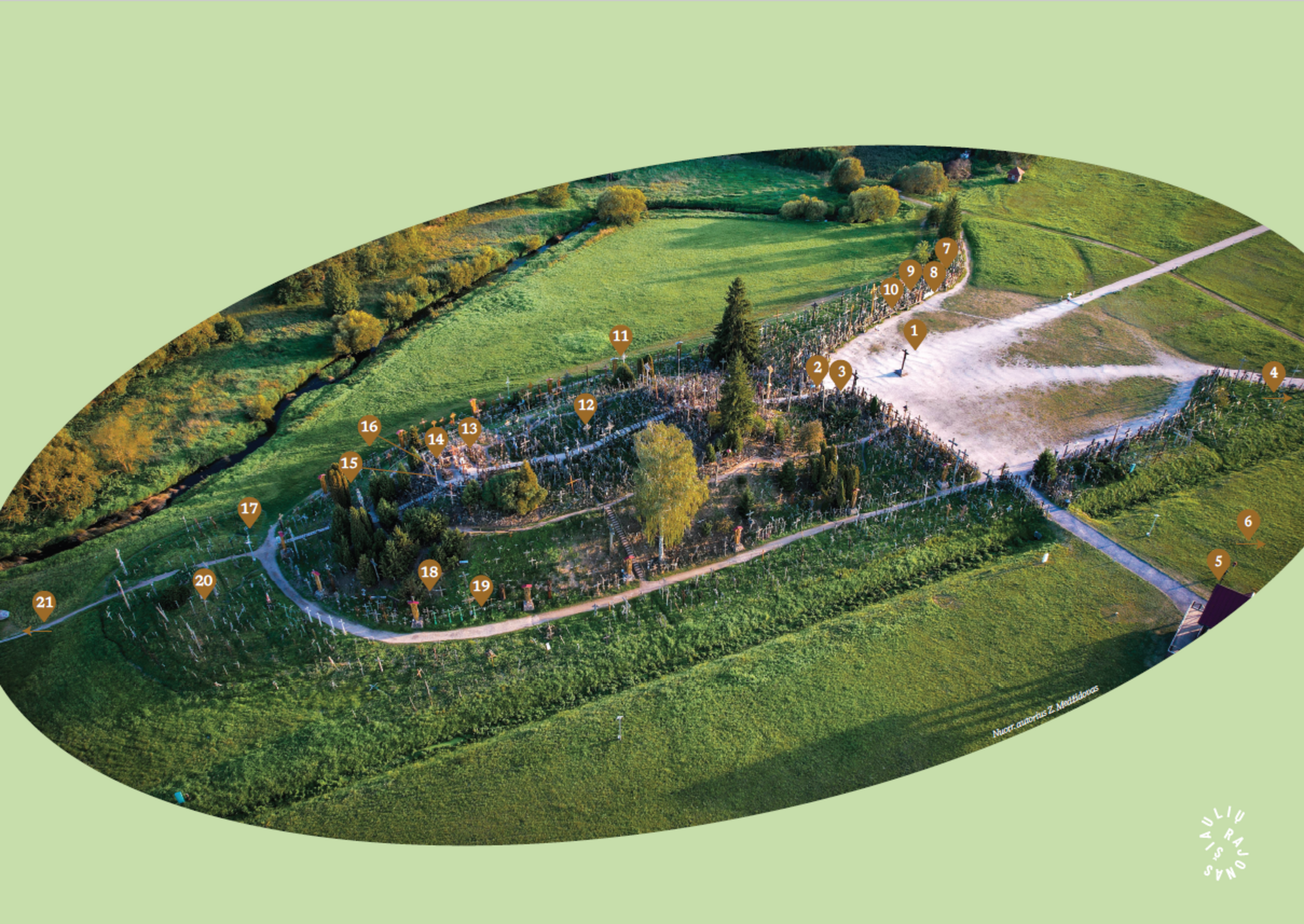
1.The Cross of Saint John Paul II
The most significant event in the history of the Hill of Crosses, which brought it international recognition, was the visit of Pope John Paul II on 7 September 1993. The Pope subsequently referred to his visit on numerous occasions in his speeches. A year later, Lithuania received a gift from the Holy Father: a 3.8-metre-tall Lithuanian oak cross with a crucifix, sculpted by E. Manfrini.
2. The Blessing Christ Sculpture
The sculpture, created by the folk artist Zigmas Vaišvila, welcomes and blesses all who visit the Hill of Crosses. According to accounts, there were attempts to demolish the Blessing Christ, yet the sculpture withstood all adversities and remains standing to this day.
3. The Cross for Those Who Died on January 13
The cross, created by folk artist Zigmas Vaišvila, commemorates the events of 13 January 1991, when Soviet military units attempted to suppress Lithuania’s independence by storming the Vilnius TV Tower and the Radio and Television Committee building. That night, 14 people were killed and more than 1000 were injured.
.jpg)
4. Sculpture of St. Roch
The sculpture, erected in 2020, was dedicated to protecting Lithuania from the Covid-19 pandemic. It was created by the folk artist Jonas Bugailiškis.
5.The Chapel at the Hill of Crosses
The chapel near the Hill of Crosses was constructed for Pope John Paul II’s visit to Lithuania, during which Holy Mass was celebrated here in the presence of thousands of faithful. Although initially intended as a temporary structure, the chapel remained in place due to strong public support, its historical significance and its subsequent inclusion in the list of cultural heritage sites. As a result, it came to be preserved as an important monument in the history of Lithuanian culture and religion.
6. The Cross in Memory of Police Officer Tomas Naumovas
At the Hill of Crosses stands a monument dedicated to Tomas Naumovas, a 22-year-old police officer from the Šiauliai district who was killed in the line of duty. On 26 September 1995, while on guard near the hill, he was attacked by a criminal and fatally injured. Following this tragic event, Naumovas became the model for the main character in Rimantas Kmita novel Remyga.
.jpg)
7. The Public Security Service Cross
On 21 October 2025, officers of the Kaunas unit of the Public Security Service ceremonially erected their first cross at the Hill of Crosses. The cross is dedicated to all members of the service and commemorates colleagues who tragically lost their lives, particularly the soldiers of the 1st Regiment of the Internal Service who were killed near Marijampolė on 1 July 1992.
8. Crosses Erected in Honour of Those Fighting for Ukraine’s Freedom
On 19 April 2019, soldiers who had participated in Ukraine’s anti-terrorist operation and were wounded erected the twentieth Ukrainian Soldiers’ Cross at the Hill of Crosses. The cross is dedicated to those fighting for their country’s freedom and independence and serves as a symbol of gratitude to Lithuania.
9. Monument to Fallen Partisans
The monument is dedicated to the partisans of the Lithuanian freedom movement who were killed between 1944 and 1954 while defending Lithuania’s freedom and independence. Each cross-shaped memorial bears the name of one of the ten partisan districts that operated in Lithuania during that period.
.jpg)
10. Khachkar
A khachkar is a sacred Armenian memorial monument. In 2001, the Armenian community in the Baltic States erected a khachkar at the Hill of Crosses, carved from Armenian tuff, to commemorate the 1,700th anniversary of the introduction of Christianity in Armenia.
11. The Stations of the Cross
The Stations of the Cross is a devotional practice that originated as a commemoration of the Via Dolorosa (the painful way) in Jerusalem. The path symbolises fourteen stations, representing the journey of Jesus Christ from his sentencing to his crucifixion and burial. The faithful reflect on Christ’s suffering, death, and love, as well as human virtues such as strength, endurance, and humility.
12. The Camino Lituano Cross
The Camino Lituano Cross was erected at the Hill of Crosses in 2025 during the Šiauliai–Naisiai pilgrimage, commemorating the significance of this site for pilgrims. As the route passes through the Hill of Crosses, the location has become an important station where pilgrims pray, rest, and leave crosses.
.jpg)
13. Cross of Caravaca
The Cross of Caravaca was erected in 2013. This Lithuanian double-cross design was inspired by the preserved Cross of Caravaca in Caravaca de la Cruz, Spain. According to Vilius Puronas, the cross was erected to commemorate the tenth anniversary of the restoration of the Jotvingian Order.
14. Statue of the Blessed Virgin Mary
The statue of Mary at the Hill of Crosses serves as a symbol of perseverance. The first statue was erected in 1978 and remained in place until 1993. During his visit to the Hill of Crosses, Pope John Paul II blessed the statue; however, shortly afterwards it was damaged by fire and vandalism, and its remains were interred at the site. In 1994, a second statue of Mary, more elaborate and colourful and adorned with a golden crown, was erected, becoming one of the principal features of the hill until 2011, when it was demolished by its original commissioner, A. Vėberis. The current, third statue was erected in 2012 and continues to welcome visitors to the Hill of Crosses.
15. Memorial Stone for the 1863 Uprising
A memorial stone at the Hill of Crosses was erected in 1963 to mark the centenary of the 1863 uprising. The 1863 uprising was a revolt by the peoples of the former Grand Duchy of Lithuania and the Kingdom of Poland against the Russian Empire. Many patriots took part, striving to restore independence and defend the freedom of their homeland.
.jpg)
16. Crosses Dedicated to the Popes
These crosses are dedicated to honoring Popes Benedict XVI and Francis, the leaders of the Roman Catholic Church in the 21st century. Although damaged by fire, the popes’ crosses have endured as a testament to steadfast faith and spiritual resilience.
17. Cyclists’ Cross
On 15 September 2012, a Cyclists’ Cross was erected, and on this occasion more than a thousand cyclists arrived at the Hill of Crosses, representing the cycling culture of the Šiauliai region.
18. TAU Cross
The Franciscan TAU Cross at the Hill of Crosses appeared around the year 2000. It is believed that it may have been erected by Franciscan friars to embody the spirituality of St. Francis of Assisi. Symbolising humility, penance, and a simple Christian life, the T-shaped cross invites quiet prayer and inner contemplation.
.jpg)
19. The Monastery 25th Anniversary Cross
The cross was erected to commemorate the 25th anniversary of the Monastery of the Hill of Crosses of the Lithuanian St. Casimir Province of the Order of Friars Minor. It was created at the initiative of the Šiauliai District Tourism and Business Information Centre and designed by the folk artist Vaclovas Tamošaitis.
20. Sculpture Memorializing the Lithuanian Deportees to Siberia
The sculpture memorializing the Lithuanian deportees to Siberia serves as a testament to one of the most painful chapters in Lithuania’s history. Between 1941 and 1952, approximately 130,000 people were deported from Lithuania to Siberia, where they endured severe repression, and many never returned to their homeland.
21. Monastery of the Hill of Crosses
A few weeks after his visit to Lithuania, during a trip to Italy, Pope John Paul II observed that Europe possesses two exceptional mountains — La Verna and the Hill of Crosses — suggesting that a symbolic (spiritual) bridge might connect them. He encouraged the Italian Franciscans to found a monastery near the Hill of Crosses, and the monastery was solemnly consecrated on July 8, 2000.
.jpg)
Sources of Information
-
Meilutė Šimaitė
-
Rita Bagdonaitė. Šiaulių vyskupas D. Trijonis: Kryžių kalnas – universali pamaldumo vieta ne tik katalikams. Bernardinai. Link
-
Lietuvos policija. Eidami tarnyba. Link
-
Lietuvos policija. Panoramos archyvai: nusautas policininkas. LRT. Link
-
Alvydas Januševičius. Kulkomis, kujais ir ugnimi šventintas Kryžių kalnas – žmonijos sielos atspindys. 15min. Link
-
Viešojo saugumo tarnyba prie Vidaus reikalų ministerijos. Kryžių kalne iškilo ir Viešojo saugumo tarnybos kryžius. Link
-
V. Puronas. Kryžių kalno mįslės. Istorija, legendos, paslaptys.
© Šiauliai District Tourism and Business Information Centre, 2026
Photos from the archives of the Šiauliai District Tourism and Business Information Centre
Information:
7 St. John Paul II St., Domantai Village, Meškuičiai Eldership, Šiauliai District
Phone: +370 41 37 08 60
Email: [email protected]
Reviews