

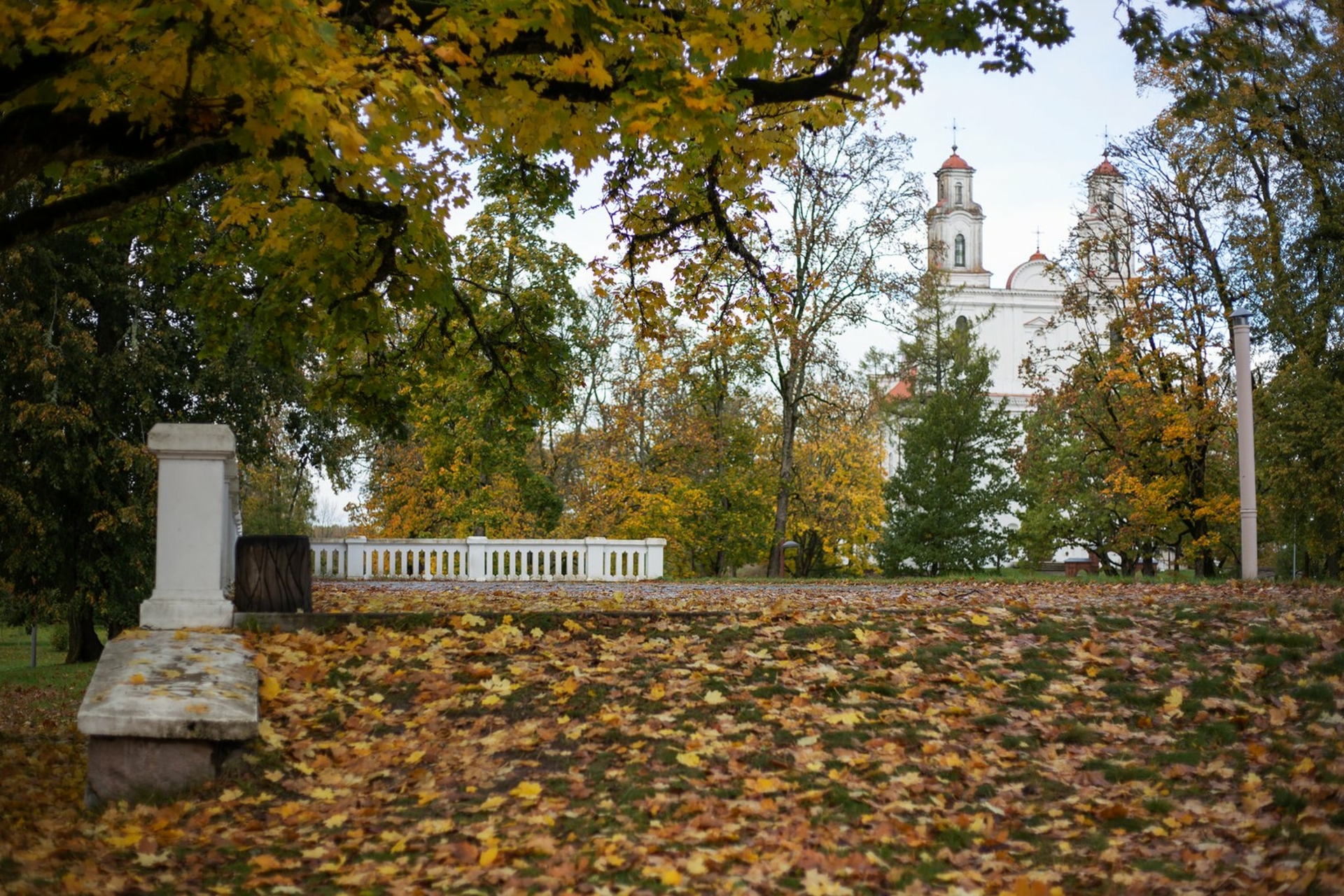
Area – 13.6 ha.
Within the territory of the Kurtuvėnai Regional Park there are the homesteads of six former manor estates: Bubių, Gelučių, Kurtuvėnų, Mirskiškės, Šaukėnų, and Šilo Pavėžupis (Putvinskiai). The Kurtuvėnai Manor is mentioned in historical sources as early as the first half of the 16th century. The surviving manor inventories from 1592 do not yet mention any plantings around the estate. The first references to the manor’s gardens appear in inventories from 1674. At that time, the plantings likely consisted of local trees and shrubs, as introduced species began to be planted in Lithuanian parks only toward the end of the 18th century. It was precisely around that period that the manor’s greenery was heavily damaged, and not a single fruit tree remained.
From 1716 until the end of the 18th century, the Nagurski family owned the Kurtuvėnai estate. During their rule, a new manor garden was established.
There is reason to believe that the present-day park began to take shape at the end of the 18th century. A 1796 agreement between the manor owner and the well-known Vilnius garden architect of the time, Kazimierz Bolman, has survived. It states that Bolman was to work in Kurtuvėnai for two weeks during the reconstruction of the manor park and, over a period of five years, train one young apprentice in the art of gardening. It is assumed that a geometric-style park was formed at that time. Evidence of such a layout remains today in the form of straight tree alleys characteristic of geometric parks. From the late 18th century, a cobblestone path near the old manor well has also survived.
In the second half of the 19th century, the estate was purchased by the Zyberk-Plater family. From 1862, the Kurtuvėnai lands belonged to Henrikas Plateris, who later transferred the estate to his son Ludwik, married to Teresa Zamoyska.
The Plater family managed the estate skillfully and cared for the well-being of the town. They created numerous ponds and established an active cultural centre on the estate grounds.
In the late 19th century, new manor palace buildings were constructed in place of the old ones, and the surrounding park was also redesigned. After reconstruction, it acquired the features of a landscape park with elements of geometric design. In the second half of the 20th century, the park was reconstructed once again and now features an irregular network of straight paths.
During the Plater period, the estate could be accessed through beautiful gates located on the side of the church. Behind the granary there was an orchard with apple trees and currant bushes, and nearby stood the gardener’s house.
In 1901, Countess Plater invited P. Višinskis to the estate to educate her children, and he lived there until 1903.
The manor palace burned down during the First World War. The park was well maintained until the Second World War. Before the war, a tennis court and a children’s playhouse were built on a hill within the park.
There were three ponds in the estate; two have survived. One is located near the mentioned hill, and the other behind the granary. From the north and east sides, the manor park was historically enclosed by a masonry wall, as well as wooden fences with brick pillars (only fragments remain).
In 1940, the estate was nationalized.
Research carried out in 1996 in the Kurtuvėnai Manor Park identified numerous native tree and shrub species, including pedunculate oak, silver and downy birch, grey willow, aspen, Norway spruce, white willow, field elm, common bird cherry, Norway maple, rowan, ash, hazel, European spindle, and alpine currant. Introduced tree species included horse chestnut, large-leaved lime, European larch, Douglas fir, western thuja, balsam poplar, and staghorn sumac. Introduced shrubs included common lilac, mock orange, smooth hydrangea, cotoneaster, snowberry, common bladderwort, white dogwood, and golden currant.
Only a part of the old manor garden has survived.
For a long time, the oldest and most valuable building on the estate was a wooden granary built around 1796 without the use of nails. It had a rectangular plan, two floors with an attic, a mansard hip roof, columns, and ornamented doors. In 2002, it was destroyed by arson committed by unknown perpetrators. Before the fire, the granary had been conserved and restored. In the 19th century, the landowner Nagurskis, after traveling abroad, planned to establish a serf theatre in the granary, where dances and songs were performed and theatrical productions were shown to guests. During the First World War, German forces used it for grain storage.
Today, the administration of the Kurtuvėnai Regional Park is located in a historic red-brick building within the park. The Kurtuvėnai Park is a popular place for gatherings and recreation. A sculpture titled “Perkūno Medis” (“Thunder Tree”) stands in the park. The area is rich in edible snails, and tree hollows host five species of bats, as well as owls, eagle-owls, and woodpeckers.
On 31 December 1997, the Kurtuvėnai Manor ensemble, valued for its architectural, historical, and landscape significance, was included in the Register of Lithuanian Cultural Heritage Sites (code G112K). The complex now includes the park, office building, cattle barn, stable, kitchen, barn, cellar, and two former servant houses. In recent years, the park has been well maintained under the care of the Kurtuvėnai Regional Park administration.
Reviews